Understanding the Two Most Popular Crown Materials in Modern Dentistry
If you are researching dental crowns, you have almost certainly come across two names: E-max and zirconia. These are the two dominant materials in modern cosmetic and restorative dentistry, and choosing between them is one of the most important decisions you will make during your treatment.
Both materials produce excellent results when used correctly. The question is not which one is universally better — it is which one is right for your specific situation. This guide gives you a clear, honest comparison so you can have an informed conversation with your dentist.
What Is E-max?
E-max (IPS e.max) is a lithium disilicate glass ceramic manufactured by Ivoclar Vivadent, a Swiss dental materials company. It was introduced in 2005 and has become the gold standard for aesthetic dental restorations.
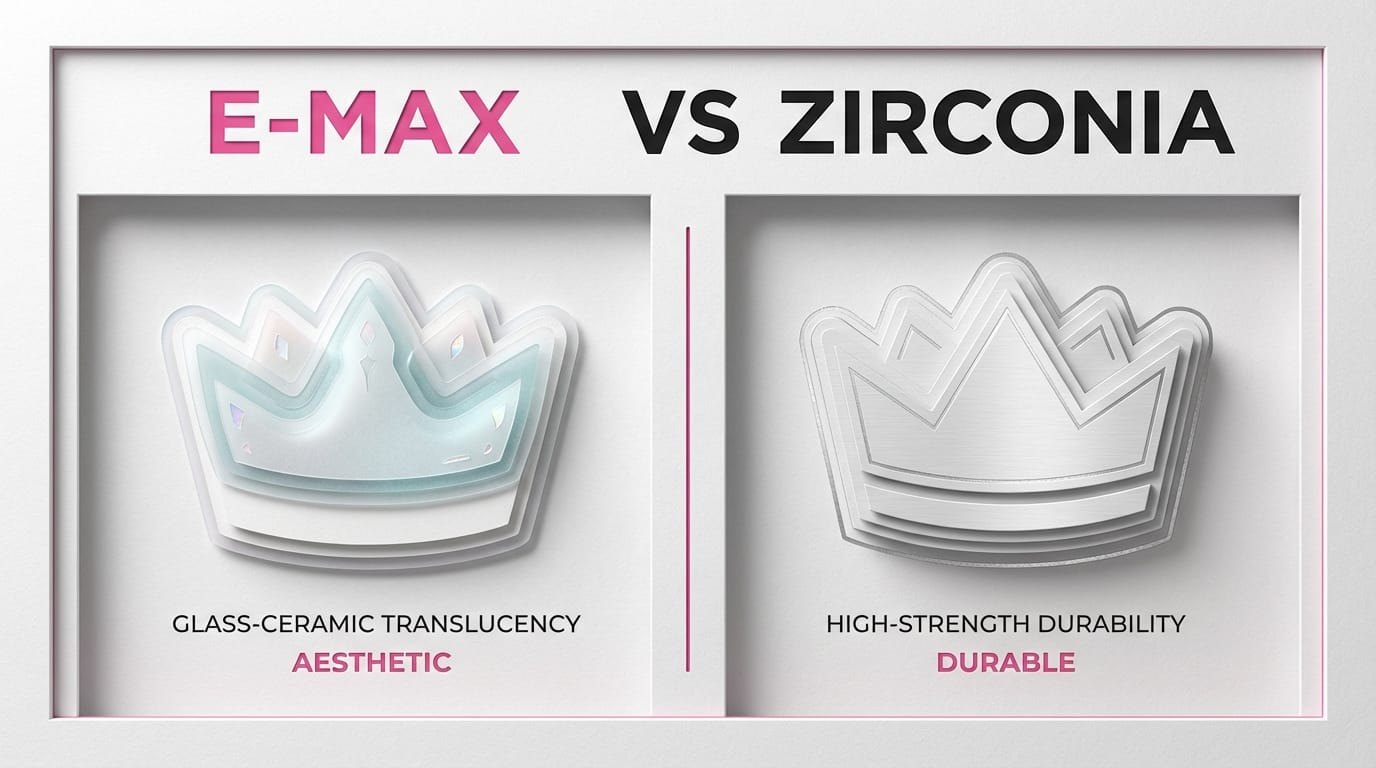
E-max is known for its exceptional translucency, which allows it to mimic the appearance of natural tooth enamel more closely than almost any other material. Light passes through an E-max restoration in a way that closely replicates how light behaves in a natural tooth, creating a lifelike appearance that is very difficult to distinguish from real teeth.
The material has a flexural strength of approximately 400–530 MPa, which is strong enough for most dental applications but not as strong as zirconia. It is ideal for front teeth, veneers, inlays, onlays, and single crowns where aesthetics are the primary concern.
What Is Zirconia?
Zirconia (zirconium dioxide) is a ceramic material known primarily for its extraordinary strength. With a flexural strength of 900–1,200 MPa, zirconia is the strongest ceramic material available in dentistry — roughly two to three times stronger than E-max.
Traditional zirconia had a reputation for being very opaque and artificial-looking, making it suitable for back teeth but less ideal for visible areas. However, modern multi-layered zirconia (such as Katana Zirconia by Kuraray Noritake) has dramatically improved in aesthetics, with graduated translucency that much more closely mimics natural teeth.
Zirconia is the preferred choice for posterior crowns, bridges, implant-supported restorations, and any situation where maximum strength is required.
Aesthetics: How Do They Look?
E-max wins on aesthetics in most situations, particularly for front teeth. Its translucency, colour depth, and ability to replicate the subtle gradations of natural enamel make it the preferred material when appearance is the top priority. A skilled ceramist can create E-max restorations that are virtually indistinguishable from natural teeth.
Modern zirconia has closed the aesthetics gap significantly. Multi-layered zirconia crowns now offer a level of translucency that was unimaginable five years ago. For back teeth and many premolar positions, the aesthetic difference between high-quality zirconia and E-max is negligible to the naked eye.
However, for the front six to eight teeth where light exposure is highest and close-up scrutiny is most likely, E-max generally produces a more natural appearance. This is why many cosmetic dentists, including our team at Persona Smile, recommend E-max for veneers and anterior crowns.
Strength and Durability: Which Lasts Longer?
Zirconia is significantly stronger than E-max. In raw strength terms, zirconia outperforms E-max by a factor of two to three. This makes zirconia the better choice for areas of the mouth that experience heavy biting forces — molars, premolars, and long-span bridges.
That said, E-max at 400–530 MPa is more than strong enough for single crowns and veneers on front teeth. The likelihood of an E-max crown fracturing under normal function is very low. Problems typically arise only with excessive grinding (bruxism) or traumatic impact.
For patients who grind their teeth, zirconia is generally the safer option across all positions. If you know you are a grinder, discuss this with your dentist — a night guard is also recommended regardless of which material you choose.
Tooth Preparation: How Much Tooth Is Removed?
E-max restorations can be made thinner than zirconia while maintaining adequate strength. This means less natural tooth structure needs to be removed during preparation — typically 0.5 to 1.0mm for E-max compared to 1.0 to 1.5mm for zirconia.
Preserving tooth structure is always preferable from a long-term dental health perspective. Less preparation means a stronger remaining tooth and more options for future treatment if ever needed. This is another reason why E-max is often preferred for veneers, where minimal preparation is a key advantage.
Biocompatibility
Both materials are highly biocompatible, meaning they are well tolerated by the body and do not cause allergic reactions or tissue irritation. Both are metal-free, making them suitable for patients with metal allergies or sensitivities who cannot wear traditional metal-ceramic (PFM) crowns.
Zirconia has a slight edge in terms of plaque resistance — its surface properties make it marginally less hospitable to bacterial adhesion compared to some other dental materials. However, the practical difference in plaque accumulation between E-max and zirconia is minimal when proper oral hygiene is maintained.
Cost Comparison
At Persona Smile, the pricing reflects the material and manufacturing complexity involved:
Zirconia crowns are priced from £130 per tooth, while E-max crowns are priced from £150 per tooth. E-max lumineers (ultra-thin veneers requiring minimal or no preparation) are available from £180 per tooth. For comparison, metal porcelain crowns start from £95.
In the UK, the same crowns would typically cost £500–£1,000 for zirconia and £600–£1,200 for E-max. The savings at Persona Smile are substantial, and critically, we use the same internationally certified materials as leading UK and European practices.
When to Choose E-max
E-max is typically the best choice when aesthetics are the primary concern, for front teeth (incisors and canines) where translucency matters most, for porcelain veneers and lumineers, for single crowns in visible areas, and when minimal tooth preparation is desirable. It is also an excellent choice for patients having a smile makeover where the front teeth are the focal point.
When to Choose Zirconia
Zirconia is typically the best choice for back teeth (premolars and molars) where biting forces are highest, for dental bridges especially three or more units, for implant-supported crowns and bridges, for patients who grind their teeth, and for situations where maximum durability is the priority. It is also the material of choice for full-arch restorations on All-on-4 or All-on-6 implants.
The Combined Approach: Why Many Patients Use Both
For patients having multiple teeth restored, the smartest approach is often to use both materials strategically. E-max for the front teeth where aesthetics matter most, and zirconia for the back teeth where strength is the priority. This combination gives you the best of both worlds — a beautiful, natural-looking smile at the front with maximum durability at the back.
This is a common recommendation at Persona Smile, and our in-house laboratory ensures perfect colour matching between the two materials so the transition is seamless.
Frequently Asked Questions
Can you tell the difference between E-max and zirconia crowns?
On back teeth, most people cannot tell the difference. On front teeth under close inspection, E-max typically looks more natural due to its superior translucency. Modern multi-layered zirconia has narrowed this gap significantly, but E-max remains the aesthetic benchmark.
How long do E-max and zirconia crowns last?
Both materials can last 15 years or more with proper care. Clinical studies show survival rates above 95% at 10 years for both E-max and zirconia restorations. The longevity depends heavily on oral hygiene, grinding habits, and the quality of the original preparation and fit.
Are zirconia crowns better than E-max for implants?
For implant-supported restorations, zirconia is often preferred because of its superior strength. Implant crowns experience slightly different forces than crowns on natural teeth, and the extra strength of zirconia provides an additional safety margin.
Which material does Persona Smile recommend?
We recommend the material best suited to each tooth’s position and function. During your consultation, your dentist will explain which material is optimal for each tooth in your treatment plan. Check our price page for current pricing on all materials.