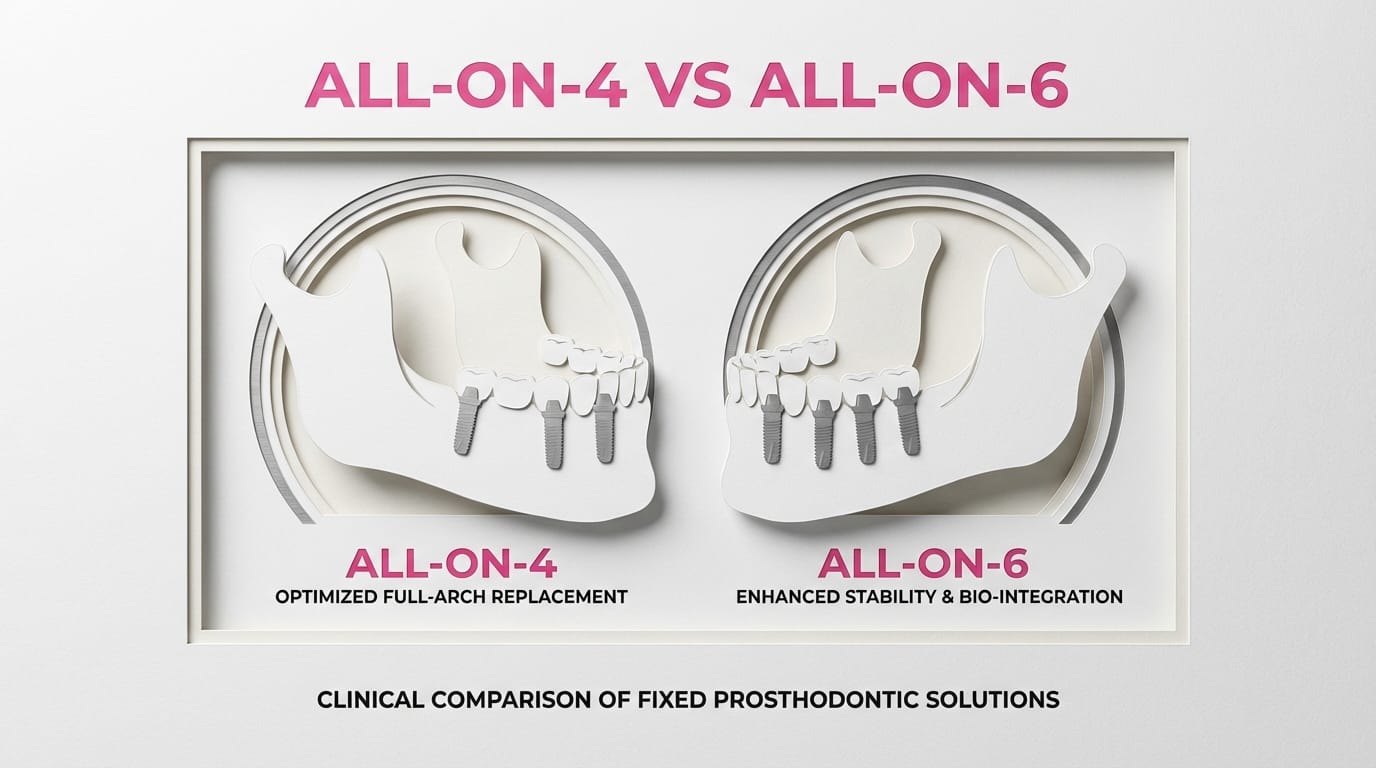
Full-Arch Implant Solutions: Understanding Your Options
If you have lost most or all of your teeth, or if your remaining teeth are failing and need to be replaced, full-arch implant systems offer a permanent, fixed solution that looks and functions like natural teeth. The two most established protocols are All-on-4 and All-on-6, and understanding the difference between them is essential for making the right decision.
Both systems work on the same fundamental principle: a complete arch of teeth is fixed permanently onto a small number of dental implants, eliminating the need for removable dentures. The difference lies in how many implants are used, how the force is distributed, and which patients are best suited to each approach.
How All-on-4 Works
The All-on-4 concept, originally developed by Nobel Biocare, uses exactly four implants to support a full arch of teeth. Two implants are placed vertically at the front of the jaw, and two are placed at an angle (typically 30 to 45 degrees) at the back. The angled placement achieves three critical objectives: it avoids the need for bone grafting in many cases, it maximises contact with available bone, and it provides a wider spread of support for the prosthetic arch.
The angled posterior implants are the defining innovation of the All-on-4 system. By tilting the implants, the surgeon can anchor them in denser bone at the front of the jaw while reaching further back to support the molars, all without needing to graft additional bone or navigate around the sinus cavities in the upper jaw.
A temporary fixed bridge is typically attached on the same day as surgery, meaning you leave the clinic with functional teeth. The permanent bridge is fabricated after the healing period, usually three to six months later.
How All-on-6 Works
The All-on-6 protocol uses six implants per arch instead of four. The additional two implants provide extra support points, distributing the biting forces across six anchorage sites rather than four. This creates a more robust foundation, particularly for patients with adequate bone volume.
The implant placement typically includes two vertical implants at the front, two angled implants at the back (similar to All-on-4), and two additional implants in the premolar region. This wider spread of implant positions allows for better force distribution and can support a longer bridge that extends further back in the mouth, potentially restoring more teeth.
Key Differences Compared
Number of Implants and Force Distribution
The most obvious difference is the number of implants: four versus six. More implants generally means better force distribution, which can reduce stress on individual implants and the surrounding bone. This is particularly relevant for patients who have strong bite forces or who eat hard, crunchy foods regularly.
With All-on-4, each implant bears 25% of the total biting load. With All-on-6, each implant bears approximately 17%. This reduced per-implant load can theoretically improve long-term outcomes, though both systems have excellent survival rates when properly planned and executed.
Bone Requirements
All-on-4 was specifically designed for patients with reduced bone volume. The angled implant technique allows treatment even in jaws where bone loss has occurred, often eliminating the need for bone grafting procedures. This makes All-on-4 the better option for patients who have been told they do not have enough bone for conventional implants.
All-on-6 typically requires more bone to accommodate the two additional implants. Patients with significant bone loss may need supplementary procedures such as bone grafting or sinus lifts before All-on-6 can proceed, adding time and cost to the treatment.
Surgical Complexity
All-on-6 surgery takes longer than All-on-4 because two additional implants must be placed. The surgical procedure is slightly more complex, and the healing period is comparable. Both procedures are performed under local anaesthesia with sedation available for anxious patients.
Prosthetic Design
The bridge supported by All-on-6 can often extend further back in the mouth, restoring up to 14 teeth compared to the typical 10 to 12 with All-on-4. This means better chewing efficiency because more molar teeth are restored.
Cost Comparison
At Persona Smile, the pricing for full-arch implant systems is as follows:
All-on-4 with NTA (Swiss) implants starts from £3,830 per arch. All-on-4 with Straumann BLX implants starts from £5,210 per arch. All-on-6 with NTA (Swiss) implants starts from £4,540 per arch. All-on-6 with Straumann BLX implants starts from £6,610 per arch.
In the UK, All-on-4 typically costs £12,000 to £20,000 per arch, and All-on-6 costs £15,000 to £25,000. The savings at Persona Smile are considerable — often 60% to 75% — while using the same internationally certified implant systems.
Which System Is Better for You?
All-on-4 may be better if:
You have experienced significant bone loss and want to avoid bone grafting. You want the most cost-effective full-arch solution. You are looking for the shortest possible treatment time. Your bone density is limited, particularly in the posterior regions. You want a proven protocol with over 20 years of clinical evidence.
All-on-6 may be better if:
You have adequate bone volume across the jaw. You want maximum long-term stability with extra implant support. You prefer the security of additional anchorage points. You have a strong bite or grind your teeth. You want the bridge to extend further back to restore more molar teeth.
Implant Brand Matters: NTA vs Straumann
At Persona Smile, we offer both NTA (Swiss) and Straumann BLX implant systems. Both are CE-marked, internationally certified, and manufactured in Switzerland.
Straumann is widely regarded as the world’s leading implant brand, with the most extensive body of clinical research and the longest track record. The BLX system features an innovative design that achieves high primary stability even in compromised bone, making it particularly well suited to immediate loading protocols (teeth on the same day).
NTA implants are also Swiss-manufactured and CE-certified, offering excellent performance at a more accessible price point. For patients where budget is a factor, NTA provides a reliable, well-documented alternative.
The Treatment Process at Persona Smile
Whether you choose All-on-4 or All-on-6, the process at our clinic follows a structured protocol. Your journey begins with a remote consultation where we assess your suitability and provide a preliminary plan. On arrival in Antalya, a comprehensive clinical assessment including CBCT scanning determines the final treatment plan.
Surgery is performed using guided implant placement for maximum precision. A temporary fixed bridge is attached on the same day in most cases. After a healing period of three to six months, you return for the final permanent bridge, custom-crafted in our in-house laboratory.
Our state-of-the-art facilities include dedicated surgical suites and advanced imaging technology to ensure safe, predictable outcomes.
Frequently Asked Questions
Can I eat normally with All-on-4 or All-on-6?
Yes. After the initial healing period, both systems allow you to eat virtually anything. The permanent bridge is designed to withstand normal biting forces including hard and crunchy foods. During the healing period with temporary teeth, a softer diet is recommended.
How long do All-on-4 and All-on-6 implants last?
The implants themselves are designed to last a lifetime. Clinical studies on All-on-4 show survival rates above 95% at 10 years. The prosthetic bridge may need replacement after 15 to 20 years due to normal wear. Regular check-ups and good oral hygiene are essential for long-term success.
Is the surgery painful?
The procedure is performed under local anaesthesia, so you feel no pain during surgery. Post-operative discomfort is typically moderate and well managed with prescribed pain medication. Most patients report that the experience was significantly less painful than they expected.
Do I need to stay in Turkey for the entire healing period?
No. The first visit for surgery and temporary teeth takes approximately five to seven days. You then return home for the healing period (three to six months). A second visit of three to five days is needed for the permanent bridge fitting. Contact us for a detailed treatment timeline.