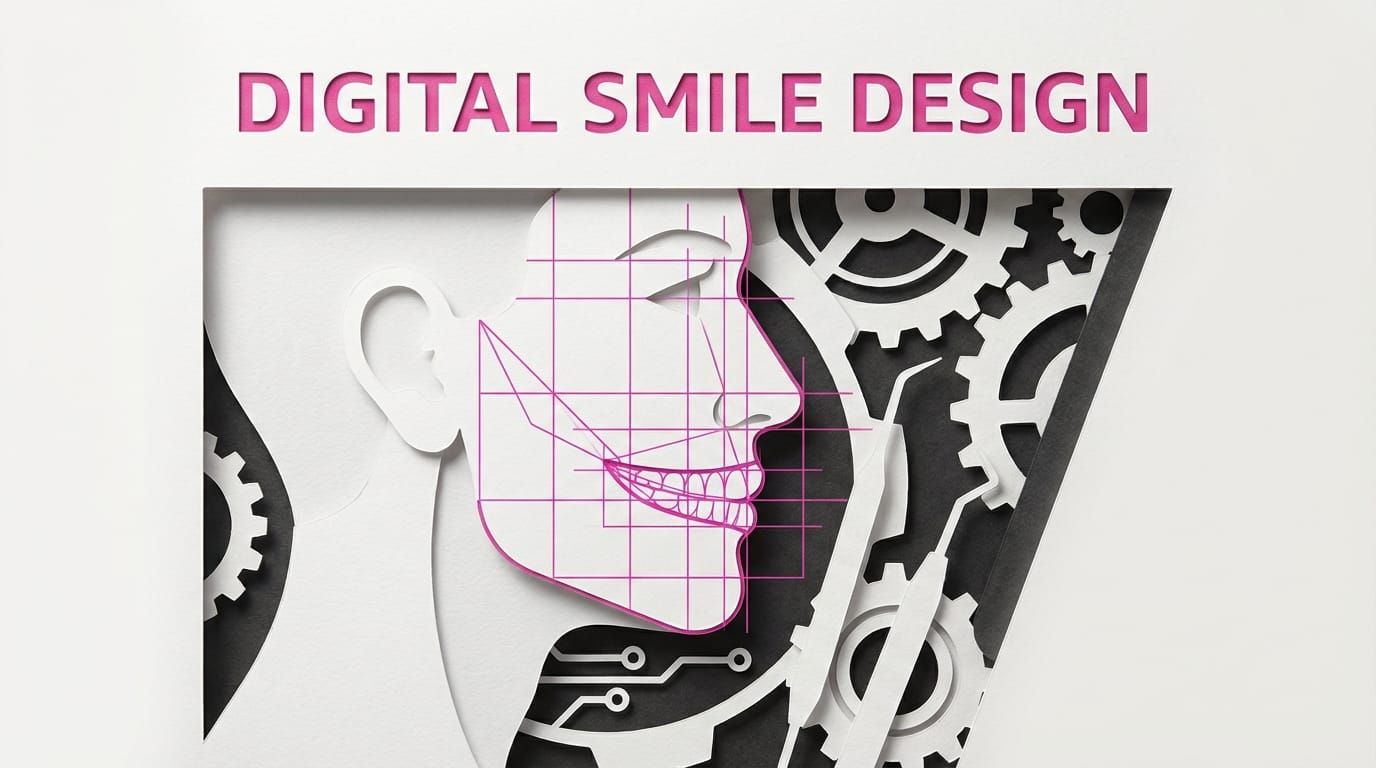
What Is Digital Smile Design?
Digital Smile Design (DSD) is a treatment planning protocol that uses digital technology to design your new smile before any clinical work begins. Instead of relying on verbal descriptions or generic before-and-after photos, DSD creates a precise visual simulation of your expected results — giving you and your dentist a shared blueprint for the outcome.
Developed by Dr Christian Coachman, the DSD concept has transformed cosmetic dentistry by replacing guesswork with data-driven design. Facial proportions, lip dynamics, gum architecture, and tooth dimensions are all analysed digitally to create restorations that complement your unique features rather than applying a one-size-fits-all template.
How the Process Works
Step 1: Digital Data Collection
The process begins with comprehensive digital records. At Persona Smile, this includes high-resolution facial photographs from multiple angles, video recordings of your natural smile and speech patterns, a full-mouth intraoral digital scan capturing every surface of every tooth, and CBCT imaging for three-dimensional bone and root assessment.
This data is imported into specialised design software where your dentist and ceramist can work together on your smile design.
Step 2: Facial Analysis and Smile Framework
Your photographs and videos are analysed against established aesthetic principles. The software maps key reference points: the interpupillary line (the line between your pupils, which defines horizontal balance), the midline of your face, the smile line (the curvature of your upper lip when smiling), and the relationship between your teeth, gums, and lips.
This facial framework ensures that your new teeth are designed in harmony with your face — not just in isolation. Teeth that look perfect on a model but ignore facial proportions often look unnatural in real life.
Step 3: Digital Tooth Design
Using the facial framework as a guide, each tooth is individually designed. The software allows precise control over tooth length, width, shape, angulation, surface texture, and colour. Your dentist can adjust these parameters in real time and show you the impact of every change.
The design accounts for functional requirements as well as aesthetics. Tooth dimensions affect how you bite, chew, and speak, so the design must balance beauty with biomechanics.
Step 4: Preview and Approval
Before any clinical work begins, you see a realistic simulation of your new smile — superimposed on your own face, not a generic model. This is one of the most powerful aspects of DSD: you can evaluate, request changes, and approve the design while everything is still digital and reversible.
Some clinics also create a physical mock-up — a temporary composite resin version of the design that is placed over your existing teeth so you can experience the look and feel in person. This is your opportunity to make adjustments before committing to the final result.
Step 5: CAD/CAM Manufacturing
Once approved, the digital design is transferred directly to CAD/CAM (Computer-Aided Design / Computer-Aided Manufacturing) systems for production. At Persona Smile, our in-house dental laboratory uses advanced milling machines and 3D printers to manufacture your restorations with micrometre precision from the approved digital file.
This digital-to-manufacturing workflow eliminates the inconsistencies that can occur with traditional impression-taking and manual laboratory techniques. The restoration you receive is a faithful reproduction of the design you approved.
Why DSD Produces Better Results
Predictability
The most significant advantage of DSD is predictability. Traditional cosmetic dentistry involves a degree of uncertainty — the patient hopes the result will look good, and the dentist uses experience and skill to deliver. DSD replaces hope with evidence. You approve a specific design, and the digital manufacturing workflow delivers that design precisely.
Communication
DSD provides a common visual language between patient, dentist, and laboratory technician. Instead of trying to describe what you want in words, you can point to specific aspects of the digital design. The laboratory technician works from precise digital data rather than interpreting verbal or written instructions.
Customisation
Every smile designed with DSD is unique to the patient. The design is based on your facial measurements, your lip dynamics, and your personal preferences — not a generic template applied to every patient. This level of customisation produces results that look natural and harmonious.
DSD and Different Treatments
Digital Smile Design is used across a range of cosmetic and restorative treatments at Persona Smile. For porcelain veneers, DSD ensures each veneer is designed to complement your facial proportions. For dental crowns, it ensures colour matching and natural proportions. For full smile makeovers, it coordinates all elements into a cohesive design.
DSD is particularly valuable for full-arch restorations on dental implants, where the entire arch of teeth is designed as a single unit. The ability to preview the complete result before surgery begins gives both patient and surgeon confidence in the planned outcome.
The Technology Behind the Design
Modern DSD workflows rely on several interconnected technologies. Intraoral scanners capture detailed 3D maps of teeth and gums without traditional impression materials. CBCT scanners provide three-dimensional imaging of bone, roots, and surrounding structures. Specialised design software integrates facial photographs with intraoral scan data. CAD/CAM milling machines cut restorations from solid blocks of ceramic with extreme precision. 3D printers produce surgical guides, temporary restorations, and models.
At Persona Smile, all of these technologies are available on-site, creating a fully integrated digital workflow from initial scan to final restoration. Explore our facilities to see the technology in action.
Frequently Asked Questions
Does Digital Smile Design cost extra?
At Persona Smile, DSD planning is incorporated into our treatment process for cosmetic cases at no additional charge. It is part of our commitment to delivering predictable, patient-approved results. Check our pricing page for treatment costs.
How accurate is the DSD preview?
The digital preview is highly accurate. The final result closely matches the approved design because the same digital data drives both the preview and the manufacturing process. Minor variations can occur due to biological factors, but the overall shape, proportions, and aesthetics should match the approved design.
Can I make changes to the design?
Absolutely. The entire point of DSD is collaborative design. You review the proposed design, provide feedback, and request changes before any clinical work begins. Multiple design revisions can be done digitally at no cost until you are completely satisfied.
Is DSD suitable for all patients?
DSD benefits any patient having cosmetic or restorative dental work, from a single crown to a full mouth restoration. It is particularly valuable for cases involving multiple teeth where coordination between restorations is essential. Book a consultation to discuss how DSD can benefit your treatment plan.